

The Director of the Institute of Innovative Governance, Dr. Anna Mysyshyn, received an invitation to testify before the U.S. Congress on artificial intelligence in the military domain and its implications for human rights.
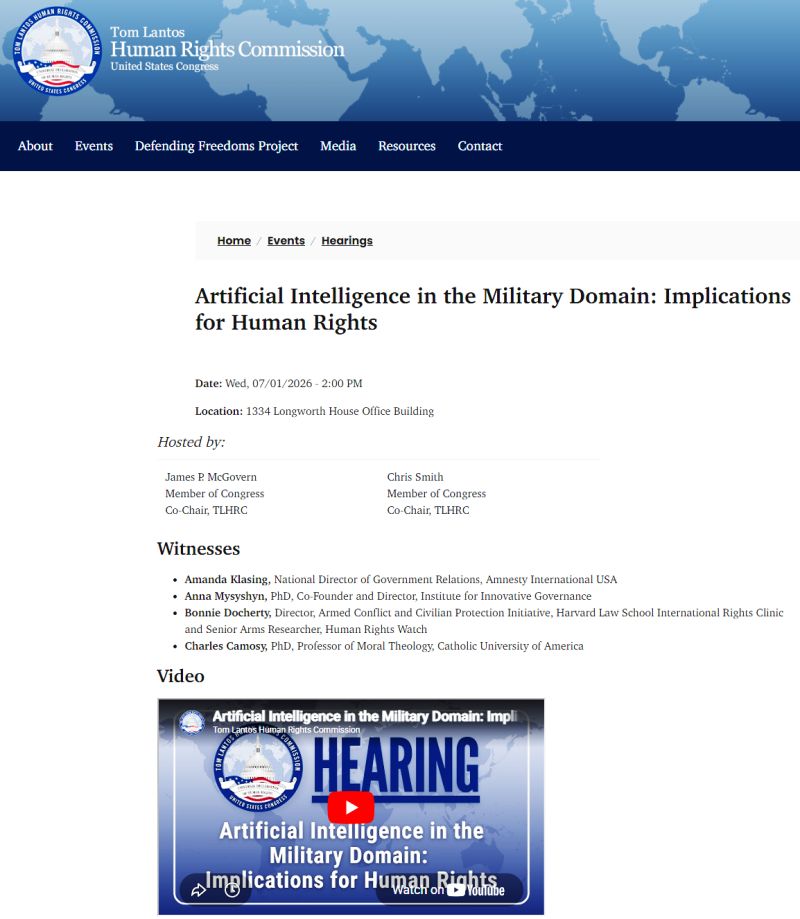
The hearing is hosted by the Tom Lantos Human Rights Commission of the U.S. House of Representatives. I will be testifying alongside experts from Amnesty International USA, Harvard Law School International Human Rights Clinic, Human Rights Watch, and Catholic University of America.
For me, this is both a professional honour and a responsibility.
For the past few years, I have been working at the intersection of technology, international law, and human rights, including through my research as a Rethink.CEE Fellow at the German Marshall Fund, my work with Global Rights Compliance, UK FCDO, the University of Edinburgh and Oxford, and my contribution to Ukraine’s legislative work on artificial intelligence.
Part of this work also informed articles for Cairo Review and Time on how Ukraine is building AI governance during wartime.
But what makes this conversation especially urgent is not only the speed of technological development. It is the fact that these questions are no longer theoretical.
AI is already being used in war.
The questions I will be addressing are not rhetorical. They are gaps in existing law with real consequences:
❗ What does “human-in-the-loop” actually mean when a single operator may oversee multiple autonomous systems at once?
❗ If an autonomous weapon is hacked, spoofed, or manipulated into striking the wrong target, with no meaningful human decision behind it, does international law have a clear answer?
❗ Article 36 of Additional Protocol I requires legal review of new weapons before use. But no internationally harmonised standard exists for AI-enabled systems. When allies operate together, whose standard applies?
Many of these legal and governance gaps are visible in real time in Ukraine: in targeting systems, dual-use technologies, cybersecurity risks, evidentiary challenges, and the erosion of meaningful human control over life-and-death decisions.
That is why I see this hearing not only as an opportunity to testify, but as an opportunity to bring Ukraine’s experience into a global conversation on AI, security, accountability, and human rights.
Link to the hearing here: https://humanrightscommission.house.gov/events/hearings/artificial-intelligence-military-domain-implications-human-rights