

In 2025, Ukraine’s national cyber incident response team, CERT-UA, processed 5,927 cyber incidents – a 37.4% increase compared to the previous year. Local government bodies were the most frequently targeted sector, accounting for 2,115 incidents, or 35.7% of the total. Meanwhile, the number of phishing incidents more than doubled, rising from 843 in 2024 to 1,727 in 2025.
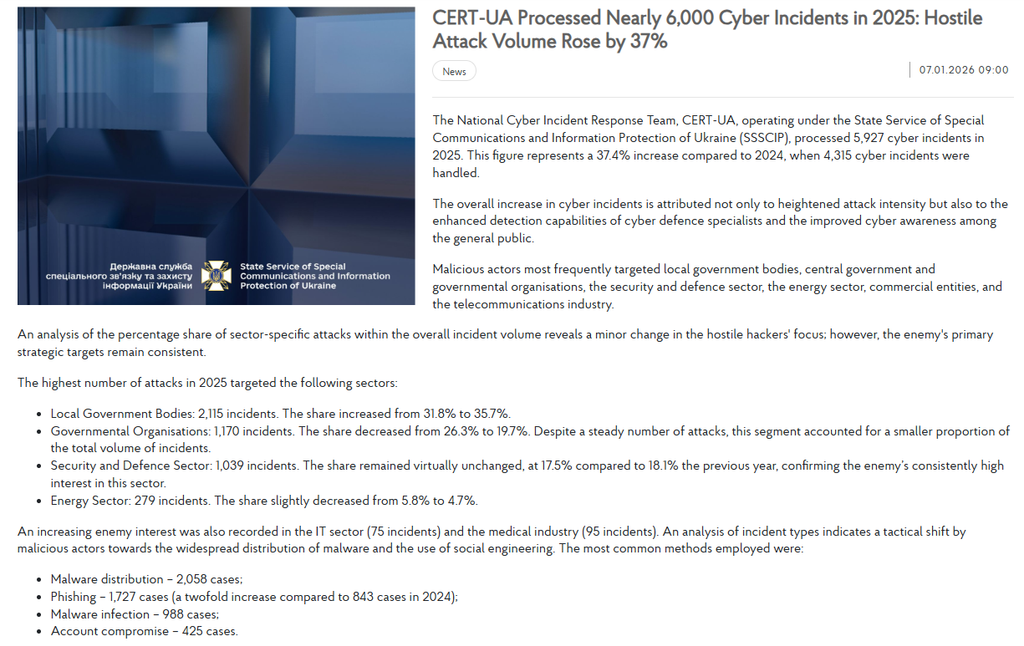
These figures reflect both the growing intensity of cyber threats and improvements in detection capabilities. However, they also raise a fundamental question: what happens after a threat is detected?
When cybersecurity and information manipulation intersect
Artificial intelligence is increasingly blurring the boundaries between cybersecurity and foreign information manipulation and interference (FIMI).
Generative AI enables malicious actors to produce realistic audio and video impersonations, synthetic documents, multilingual disinformation and highly personalised social engineering messages. These capabilities can be combined with compromised government accounts, stolen data, manipulated websites and strategically timed information leaks.
Consider a hypothetical scenario in which a fabricated video of a local government official announcing an emergency evacuation begins circulating on social media. At the same time, the municipality’s official communication channels are compromised, making it increasingly difficult for citizens to distinguish authentic information from manipulated content.
Is this a cybersecurity incident, an information manipulation operation or a crisis communication challenge?
In practice, it may be all three.
Yet institutional responsibilities, reporting mechanisms and response procedures are often organised around separate categories of threats. This fragmentation can delay decision-making precisely when a coordinated response is most needed.
The institutional response gap
Over the past several years, the Institute of Innovative Governance has worked with Ukrainian public institutions on strengthening their capacities to address AI-enabled information manipulation and cybersecurity threats.
Our research, expert consultations and capacity-building activities have highlighted the importance of moving beyond threat awareness and detection towards practical institutional preparedness.
Knowing how to recognise a deepfake or identify a suspicious message does not necessarily mean that an institution knows how to respond to it.
Public officials may face several immediate questions:
- Who is responsible for coordinating the initial response?
- How should potentially manipulated content be verified and documented?
- When should an incident be escalated to national authorities?
- How can sensitive information and digital evidence be securely preserved?
- How should an institution communicate with citizens before all the facts have been established?
- How can it respond without unintentionally amplifying harmful content?
These challenges are particularly relevant for local authorities and smaller public institutions, which may have limited access to specialised cybersecurity, strategic communications and digital investigation expertise.
Without clearly established procedures, responses risk becoming fragmented, delayed and dependent on individual experience rather than institutional capacity.
From individual expertise to institutional preparedness
Building resilience against AI-enabled threats requires more than investing in detection technologies or conducting individual training sessions. It also requires establishing sustainable organisational mechanisms that enable institutions to translate knowledge into action.
Five elements are particularly important.
1. Standardised response procedures. Public institutions need clear and accessible protocols for identifying, assessing, documenting and escalating suspected incidents.
2. Cross-functional coordination. Cybersecurity specialists, communications teams, legal advisers and institutional leadership must understand their respective responsibilities and work within a coordinated response framework.
3. Secure information management. Evidence preservation, access controls, secure communication and responsible handling of sensitive information should be integral to institutional response mechanisms.
4. Responsible crisis communication. Institutions must communicate uncertainty transparently, avoid premature attribution and minimise the risk of amplifying manipulated content.
5. Continuous institutional learning. Lessons from previous incidents should be systematically documented and incorporated into updated procedures, training and organisational practices.
These measures can help institutions move from reactive, case-by-case decision-making towards more consistent and sustainable preparedness.
The role of civil society in strengthening public-sector resilience
Civil society organisations can play an important complementary role in strengthening national cyber and information resilience.
Through independent research, technical expertise, practical guidance and established relationships with public institutions, civil society can help bridge the gap between national-level security frameworks and the operational needs of individual government bodies and local authorities.
Recognising this need, the Institute of Innovative Governance is implementing the project Strengthening Institutional Resilience for Public-Sector Response to AI-Enabled FIMI and Cyber Threats.
The initiative builds on the Institute’s previous work on artificial intelligence governance, cybersecurity and foreign information manipulation, including the development of cross-government policy recommendations with Ukrainian public-sector stakeholders.
The project focuses on strengthening the Institute’s own organisational and digital resilience, developing standardised technical-assistance procedures and establishing a sustainable mechanism to support public institutions facing emerging AI-enabled threats.
The assistance is intended to cover preliminary risk assessment, verification guidance, evidence preservation, institutional escalation, crisis communication and referral to competent national authorities.
Rather than replacing existing governmental response mechanisms, the initiative seeks to help public institutions navigate the critical initial stages of an incident and make informed decisions about further action.
Beyond Ukraine: building sustainable democratic resilience
Ukraine’s experience offers important lessons for other countries facing increasingly complex cyber and information threats.
As artificial intelligence continues to transform the information environment, democratic institutions will need to reconsider not only how they detect manipulation but also how they organise their responses to it.
Institutional resilience should not depend solely on individual experts, temporary projects or improvised responses during crises. It requires sustainable expertise, secure infrastructure, clearly defined responsibilities and mechanisms for cooperation between government institutions and civil society.
The next challenge in countering AI-enabled threats is therefore not simply technological. It is organisational.
The ability to detect an attack is essential. The ability to respond to it effectively is what ultimately determines institutional resilience.
This publication has been prepared within the framework of the project “Strengthening Institutional Resilience for Public-Sector Response to AI-Enabled FIMI and Cyber Threats”, implemented by the Institute of Innovative Governance with the financial support of the European Union, the Transatlantic Foundation and the Black Sea Trust for Regional Cooperation.